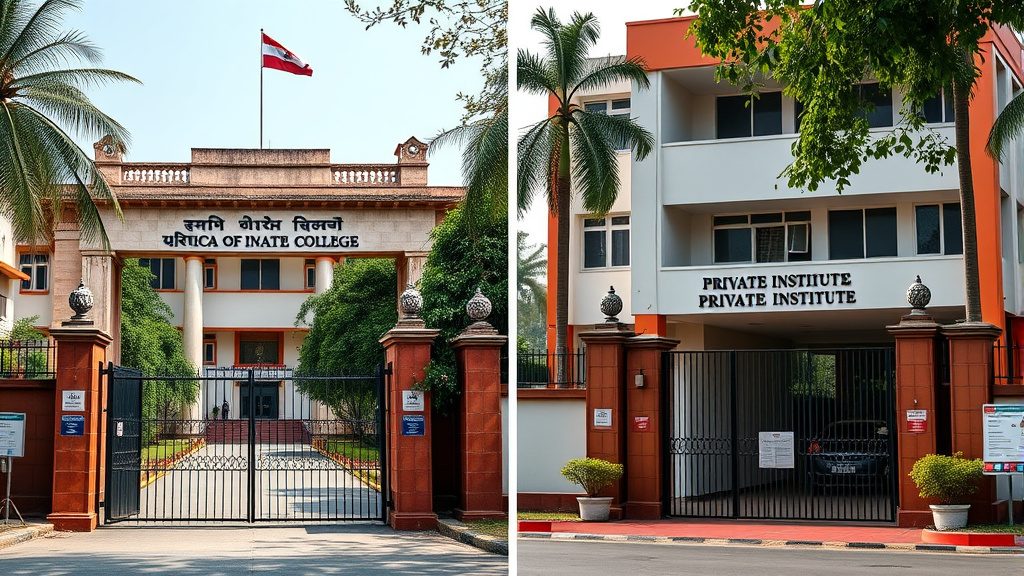
A Decision Beyond Just Fees
When choosing between a government college and a private college, many students and families default to comparing fees alone, since government institutions are generally less expensive. While cost is an important and legitimate factor, it is only one of several dimensions that should inform this decision, including faculty quality, infrastructure, admission process, campus culture and long-term outcomes in the specific field of study.
Fee Structure and Financial Considerations
Government colleges, being subsidised by central or state funding, typically charge substantially lower tuition fees than private institutions, and many also offer fee waivers, scholarships or concessions for specific categories of students as per government policy. Private colleges generally charge higher fees, reflecting their reliance on tuition revenue rather than government subsidy, though many private institutions also offer merit-based or need-based scholarships that can offset part of the cost.
Families should look beyond the headline tuition figure and also account for:
- Hostel and accommodation costs, which vary independently of tuition fees
- Additional charges such as laboratory, library or examination fees
- Available scholarships specific to the institution, beyond general government scholarship schemes
- The total cost across the full duration of the programme, not just the first year
Faculty and Academic Quality
Faculty quality varies significantly within both government and private college categories, and it is not accurate to assume uniformly stronger or weaker faculty in either category as a whole. Long-established government institutions, particularly Institutes of National Importance, often have highly experienced faculty with strong research credentials. At the same time, several private institutions have invested heavily in recruiting qualified faculty and building strong academic departments in specific fields.
Rather than generalising, students should look at faculty profiles, student-faculty ratio, and research output in the specific department or programme they are considering, at each shortlisted institution individually.
Infrastructure and Facilities
Infrastructure quality — including laboratories, libraries, hostels, sports facilities and campus technology — also varies widely and does not track neatly along government versus private lines. Some older government colleges have well-established infrastructure built up over decades, while some newer private institutions have invested significantly in modern facilities to attract students. Prospective students should, wherever possible, visit the campus or review recent, verifiable information about facilities relevant to their programme rather than relying on assumptions based on the institution’s government or private status alone.
Admission Process
Government colleges, particularly those that are Institutes of National Importance or state government institutions, generally admit students through centralised entrance exams and counselling processes, such as national or state-level engineering, medical or other professional entrance exams. Private colleges may accept the same entrance exam scores, run their own separate entrance test, or in some cases offer direct or management quota admission alongside merit-based seats, depending on the institution and state regulations. Students should understand the specific admission route, including any quota categories, for each institution they are applying to.
Placement and Career Outcomes
Placement outcomes should be evaluated at the level of the specific programme and department, not just the institution’s overall category. Well-established government institutions, especially Institutes of National Importance, often have strong placement records built on decades of industry relationships. Certain private institutions, particularly those with strong industry partnerships in specific fields, can also offer competitive placement outcomes in those fields. Students should review recent placement data published by each institution’s own placement cell for the specific programme they are considering, rather than relying on general reputation alone.
A Framework for Deciding
- List your priority factors — cost, specific department strength, location, campus culture — in order of importance for your own situation.
- Shortlist institutions in both categories that meet your academic eligibility and are realistic given the relevant entrance exam or admission process.
- Compare the total cost across the full programme duration, including hostel and other fees, against available financial aid at each institution.
- Review faculty, infrastructure and placement information specific to your intended department at each shortlisted institution.
- Consider practical factors such as distance from home, hostel availability, and campus environment, which affect day-to-day student experience regardless of institution type.
When Government Colleges Have a Clear Edge
For programmes and institutions where government colleges are Institutes of National Importance with an established reputation, strong research infrastructure and significantly lower fees, this combination is often difficult for private colleges to match directly, particularly for students prioritising affordability and established academic reputation together.
When Private Colleges May Be Worth Considering
Private colleges may be a stronger fit for students who did not secure a preferred programme or department at a government institution through the entrance exam process, or for students prioritising a very specific programme, modern facilities, or a particular location that is better served by a private institution’s offerings, provided the additional cost is financially manageable for the family.
Frequently Asked Questions
Are government colleges always cheaper than private colleges? In most cases yes, since government colleges are subsidised, but the actual cost difference and available scholarships should be verified for each specific institution rather than assumed as a fixed rule.
Do private colleges always have better infrastructure than government colleges? No, infrastructure quality varies by individual institution in both categories. Long-established government institutions often have substantial infrastructure built over time, while newer private institutions may have made more recent investments; this should be assessed case by case.
Can a student get into a well-known private college without appearing for a national entrance exam? This depends on the specific college and programme, since some private institutions admit students based on national entrance exam scores, while others conduct their own entrance test or offer a separate admission route. Students should check the specific admission process for each institution they are considering.